Dashboard/Teach & Deliver/Case Studies/Education Impact Academy Trust Case Study
Education Impact Academy Trust
Enhancing Engagement and Inclusion Using Virtual Reality in a Specialist FE College
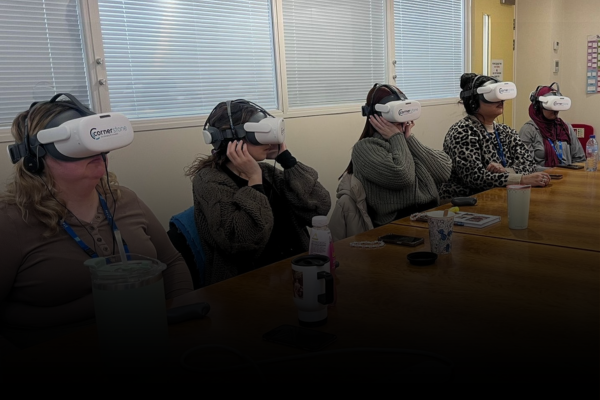
VR definitely changes the way lessons are set up and engages students in a whole new way. It lets young people with special educational needs access the same experiences as everyone else, gives them a different perspective, some chatty, some reflective, and allows them to explore situations at their own pace, seeing new things each time.
Education Impact Academy Trust
For one specialist further education college supporting learners aged 19–25, introducing virtual reality (VR) has opened new possibilities for inclusive and meaningful learning.
Education Impact Academy Trust introduced VR as a practical tool to increase engagement, support learners with a wide range of abilities and needs and bring essential life skills to life through immersive experiences.
Led by Pastoral Lead and Designated Safeguarding Lead Zoe Dockery, the initiative was designed to ensure every learner could access relevant, engaging and appropriately supported learning experiences.
The Challenge
Traditional approaches to topics such as online safety, personal development and everyday life skills were not always effective for every learner, particularly those who benefited from more visual, immersive or sensory experiences. The college wanted to improve engagement while creating inclusive opportunities for learners with complex needs and exploring how technology could support greater independence.
Alongside this, introducing VR brought practical considerations, including safely managing multiple headsets, maintaining charging routines, checking content suitability and finding a broader range of SEND-specific experiences covering areas such as sensory learning, personal hygiene, self-care and choosing appropriate clothing.
The Solution
The college introduced VR gradually through carefully planned familiarisation sessions, giving learners time to become comfortable wearing the headsets and navigating virtual environments.
Experiences included online safety, gaming behaviour and everyday scenarios from the Joe at Home series, alongside sensory content such as virtual encounters with animals. Access was adapted to individual needs, with staff holding headsets or allowing learners to use them like binoculars where appropriate. Safety remained central to the approach, with staff reviewing content in advance and considering individual requirements, including conditions such as epilepsy.
After sessions, learners also viewed 2D versions of the content to reinforce understanding, encourage discussion and improve retention. This structured approach enabled VR to become a practical learning tool rather than simply a novel technology.
The Results
The impact was quickly visible, with learners beginning to look forward to scheduled sessions as “VR day” and some groups becoming confident enough to set up the equipment independently.
Adapted delivery enabled learners with a wide range of needs to participate meaningfully, while immersive scenarios encouraged students who might previously have struggled with discussion-based activities to reflect, communicate and explore decision-making in a safe environment.
Staff also gained valuable insights into learner behaviour and understanding, while parents and partner organisations responded positively to seeing mainstream technology used effectively within a SEND setting.
Building on these results, the college is now exploring longer-term integration through staff training, mindfulness and sensory experiences, programme-specific learning pathways and opportunities for students to create VR content, positioning the technology as a sustainable tool for supporting inclusion, independence and meaningful learning.